Wednesday, October 7, 2009

Learning Not To Cry

Monday, November 8, 1965, was a gray, cold and damp day in Manhattan. It was school day, reason enough to want to turn over and seek the refuge of more sleep, an impossibility, but a lovely thought . Even the greenness of Central Park was dulled by occasional sprinkles and a blanket of thick mist in the chill of late fall in the City. Cold and uncomfortable, windy enough to penetrate the layers of clothing I wore; like a skilled lock-picker, that wind blew in strong, seemingly purposeful gusts through the cross streets and managed to make its way around and through those layers and into my bones.

Standing at my locker, I changed into dry clothes and thought about food. As was the case most days, I was looking forward to going home and getting something to eat. I tried to recall if Ellen O’Hara would be there when I arrived. Ellen was a model of all that is to be loved in the Irish people. The kindest woman ever to grace God’s Earth, probably in her mid-sixties, she lived to serve us and with her ever present smile and warm alacrity, would spare no effort in preparing whatever I came up with as an after school snack request. Her tuna salad was legendary, utilizing sweet onions, chopped into tiny perfect pieces, lots of mayonnaise and the secret, magic ingredient: chopped sweet baby gherkins pickles – with a bit of the pickle juice added for flavor. My mouth, as I stood to empty the last of my clothes from my locker, watered just thinking about it.

I had returned with my classmates from athletics, still wet and filthy from the soccer game we’d played on the Great Lawn in Central Park. I loved soccer and was good at it, always used on the front line and because I was a left-footed kicker, either as center forward, left inside, or left wing. I enjoyed the athleticism that the game required, I was very coordinated and used this to my advantage. I loved the occasional contact, the intensity of a long drive downfield, the race with the opposing team to reach the ball, the trickery and deception that one could employ to one’s benefit.

It was pouring by the end of the scrimmage and I’d been covered in mud and soaked through and through. As I tied my shoes, Mr. Dryzga’s voice called from across the locker room, with what I sensed was an almost sing-song tone that masked urgency. He addressed me with brows furled, a serious look on his usually friendly face.

“Kerry, Mr. Hume would like to see you in his office.” That tone concerned me, as did the look on his face, which, although giving nothing specific away, alerted me. That tone hid something significant, something not rooted in a discipline issue, Dryzga spoke with an agenda couched in words spoken just a bit too softly, his eyes giving away a hint of something nearly sad, but something he couldn’t betray and that I had no way of knowing. But I sensed there was more.

“Yes sir.” I managed; mentally reviewing the normally sizeable list of recent transgressions, searching my memory for what it might be that would cause me to be summoned to a personal audience with the chief.

The hierarchy consisted of the principal, David Hume, a large, generally likeable square-jawed administrator who had three sons in attendance at the school. Chris, his eldest was a classmate and casual friend of mine; the two of us would later be expelled together for using teacher’s editions to math books that Chris, good friend that he was and living in the school building as he did, had gained access to.

Peter Clifton, the Assistant Principal and Hume’s preferred henchman was in charge of any and all heavy-handed discipline, think of him as the Herman Goering of St. David’s with a little Dirty Harry cool thrown in. It was he who I was most regularly called upon to visit and who, more than any other administrative figure, I feared.

Dick Dryzga, the bottom man of the top three, was the head of the upper school.

In the dim interior of Clifton’s office, across from his desk, strategically placed just to the left of the well-worn spot on the oriental rug in front of his desk where students stood while hearing the charges against them and awaiting their fate, Clifton had what appeared to be a porcelain golf bag. Inside this vessel of terror was an assortment of long sticks and switches used for nothing but disciplining wayward boys who were brought to him. These intimidating implements of pain were used to punish students who had committed infractions that warranted an order of severity that fell outside the purview of the ordinary classroom teacher. Transgressions for which a “time-out” fell far short of the disciplinary mark (and, it seemed, all too often that mine did).

Clifton’s preferred modus operandi was to bring the guilty student, by now usually worried, perhaps even shaking or possibly wetting himself - before Clifton’s desk. Once inside the office, door shut firmly to discourage any attempt at escape, Clifton would begin the agonizing process of reviewing the facts of the case. As if in some Kafka-esque nightmare, all aspects of the infraction were reviewed in slow, painstaking detail.

Then, if the crime was so suitably punishable, he would take a deep breath, letting it out with an almost sad form of sigh, as if to imply: “Well, son, as you can plainly see - you leave me no choice…” and then send the boy over to the golf bag to choose the dreaded implement that was to be used in his own thrashing. This sadistic added touch served to both intimidate and thoroughly degrade the offender with a delicious combination of Dickensian discipline and mental cruelty, coupled with giving Clifton the personal satisfaction of whipping the daylights out of a delinquent (and in my case – a repeat offender).

But it was rare to be invited to Mr. Hume’s office. This had to be big. But what?

As I slipped on my blazer with its embroidered StD on the breast pocket, and closed my locker, Dryzga said: “I’ll wait for you, Kerry. We’ll take the elevator”. Once again - that seemingly sad flavor in his voice, he turned and walked from the locker room.

St. David’s, located 89th Street, between Madison and 5th Avenues, just around the corner from the brand new Guggenheim Museum. The school, almost exactly one mile north of our house, was likely originally built as a private residence for a wealthy family, probably in the late 1800’s. It was replete with all of the requisite amenities of the wealthy, including marble staircases with burnished bronze fixtures spiraling up to the higher floors, high ceilings under crown molding, chandeliers and crystal lighting fixtures, polished mahogany furniture and of course, as in my own house, a small, excruciatingly slow Otis elevator.

Oh, God help me, I thought. The elevator ride. This is really bad. What did I do? “Okay sir.”

To ride in the elevator – strictly off limits unless your name was Hume (and even then, absolutely verboten during a school day) – you either had to have sustained a significant injury that left you unable to traverse the stairs, or you were walking the St. David’s equivalent of your final stroll to the gas chamber.

I finished my shoe lacing, collected my school bag and belongings and joined Dryzga in the tiny, mahogany paneled elevator. My fear grew as the elevator slowly lifted us towards the fourth floor where the administrative offices of the big brass were. I had to ask.

“Sir, did I do something?” I asked timidly. I would be surprised only if I hadn’t done something. It was with great regularity that I visited the principals office. The weirdness here was that I was being called to Hume’s.

“I think Mr. Hume just needs to have a word with you about something.” was his reply, frustratingly inadequate and inconclusive. Panicking now, my heart rate rising with the elevator, I tried hard to breathe evenly.

Okay, I thought. we’ll see.

Dryzga slid the brass accordion gate open and held the outer door for me and we exited the elevator on the fourth floor. We walked down to the principal’s office, where Mr. Dryzga said. “Just sit in the waiting room. He’ll come out and see you in a minute.”

“Okay, sir”

I went in and sat on the wooden bench in the familiar waiting room, outside Hume’s office. Leaning against the wall, clasping my hands, I noted that the secretary that was usually here, a stand-offish and matronly, highly efficient woman named Mrs. Neighbor was absent. I realized that the school day, and therefore probably her day, too, was over. The bench where I’d sat before, was hard under my ass, looking back now, it must have been a strategy intended to incite the feeling of waiting in uncertainty, being sidelined during the game, warming the bench. On a few previous occasions, I’d committed acts of sufficient egregiousness to land me on this bench. I associated it with nothing but impending punishment.

The door to Mr. Hume’s office slowly opened and his face, wearing a small, forced smile, peaked around the jam.

“Come on in, Kerry”. He extended a welcoming arm.

“Yes sir”

“Have a seat, son.” Hume said in a pleasant, almost fatherly tone. I chose a hard, ladder back chair across from his desk in favor of the large, maroon pillowed one next to it. Why get comfortable now?, I thought.

“How’s life treating you, Kerry”, he asked casually, throwing me off.

How’s life treating me?, I thought. Strange way to start a scolding, if that’s what this was. I couldn’t grasp where he was going with this.

“Okay, sir. Pretty good, I guess.”

He paused. Then looked deeply into my eyes, and said:

“Kerry, your mother died this morning.”

I looked at him. He looked back, saying nothing more.

“No.” I said. I attempted a smile, as if maybe I could bait one from him, exposingthe truth – that this was a joke. Or a test. This could not be something that could really happen.

“I’m sorry, son” he added.

“No.” I repeated. The smile had pulled itself back, the elastic of my facial muscles knowing better, wanting nothing to do with it.

Hume stood and, holding out his huge arms, invited me over into his embrace. Hume was a large man. Football huge. Probably six-three with broad shoulders, a giant block of a man. His arms seemed to reach across the entire width of the room. Numbing now, I stood and walked toward him, not knowing what else to do. As I reached him, his arms enveloped me, leaning down, me reaching up.

An unfamiliar slip from reality began in the midst of those huge arms. I was lost, knowing neither what to do, nor even how to feel. Are there things to do at this moment? What are they, please, someone help me with this.

I felt as though I should cry, but there was some unseen resistance to this thought. It was not a conscious thought that I should buck-up and take this thing like a man. It was, rather, an inability, a loss of some primal connection that I felt I should be able to tap into, but could not. I could feel the absence of something inside me that was palpably missing, it. I needed to know how to cry at that moment but there wasn’t enough room in my head to somehow accept that my mother was dead and to figure out how to cry simultaneously.

Hume’s’ big arms squeezed me lightly. I stood there silent, stunned, wondering what to think.

Hume finally let his arms slip away. He stepped back and looked down at me pityingly. I looked up at him, searching his eyes for answers, seeing nothing useful there and tried to imagine what to do next.

“Someone’s coming to pick you up” he said sadly.

We took the elevator down to the lobby and there was a chauffer already waiting. He took my book bag and I followed him out into the rain.

When I arrived at the house, Ellen met me with a wounded look and a heartfelt hug. She offered me anything she could do and together we went upstairs. In the elevator, on the way to the third floor, she said:

“Your father’s in bad shape, Kerry. Just give him a little time.” This, as it turned out, was a sage warning, a wise predictor of what was to follow. This day would mark the beginning of the end of my respect for my father.

Ellen and I rode the elevator in silence, her right hand resting gently on my shoulder. I loved this woman as I loved my blood relatives, yet I could not yet find words, no questions, no statements, nothing.

As I entered the black room on the third floor, I sensed, even from behind him, my father’s misery. He sat as he always did, perched on the right side of one of the pair of black, silk-covered loveseats, his shoulders stooped and rounded, elbows leaning on his knees, the fly of his pajama bottoms pinched open enough to make us all avert our gazes, hovering over a beer. He sipped one after the other; Ellen was sure to be working hard today, keeping plenty cold and at the ready during this mourning period, glasses of Heineken one after the next, two empty bottles on the table next to the coaster that held his half-full glass.

“Hi Dad” I said.

Nothing.

“Dad?” I watched as he continued to stare ahead, seeing and saying nothing, feeling his pain somewhere else far from here. I walked slowly around the table and touched his shoulder with my hand, squeezing gently, hoping for some, any response.

Nothing.

“I’ll be upstairs, dad.”

I backed away from the table, turned and walked from the room. Again, I felt the swirl of feeling, thoughts, emotions and confusion filling my head. I went into my room and shut the door, dropping my book bag on the floor near the foot of my bed. I sat on the edge of the bed and thought.

I went upstairs and sat on the edge of my bed, thinking.

I wondered what my father was thinking about. I wondered why he wouldn’t talk to me, particularly in this time of death and sadness. Didn’t one comfort their child when times were hard? Did he not care about me? Or was it, perhaps, that he hurt so deeply, that he couldn’t find the words or even some gratuitous gesture. Could he not come out of himself long enough to offer a hug to his eleven year old son who had, after all, just lost his mother?

I didn’t feel angry at my father about this, but, rather, wholly confused and saddened. I didn’t attempt to rationalize his lack of empathy for very long. I simply took it as a sign that our family was going to crumble without my mother and that I would have to be strong. I couldn’t allow myself to whine about this, maybe I couldn’t even speak about it. Maybe that’s what happens when your mother dies. Everything falls silently to pieces. But you don’t get emotional. You don’t rage or cry or emote, at least in any outward way. You suffer silently and get through it. And so I did.

I remember thinking I’ve got to be strong here. Dad is really messed up. I have to just be really strong and I can do this. Then I thought about crying again. Should I cry? Yes, I thought, I should. So I tried to cry, but it was too late. No tears would come. I had apparently shut that door very tightly.

Of course I later saw that my father was simply a very weak man, now wounded and made weaker and more vulnerable by the loss of his wife, a woman who had given him so much. Who had given him virtually everything he had.

At the moment his eleven year old son came home from school, having just learned from a near stranger that his mother was gone forever, my father was immersed in the self-absorbed world of his personal tragedy, so self-absorbed, in fact, that he had no room in his heart to offer so much as an embrace to his also-grieving child.

Sadly, looking back over the years from the viewpoint of being a father myself, that my Dad also missed the potential value that lived in sharing this anguish with and comforting his son, that this experience, shared with each other, could be a of the deepest and most profoundly healing nature, a tool for rebuilding our already sadly deteriorated relationship before it was too late. The opportunity for a new beginning, even as we faced the most painful of endings, might have given us a new chance at a healthy life. But there was no eye contact, no hug, no words at all.

I think of my daughter, Molly and what I would do, how I might respond if a similar event occurred and Maureen was lost to us. Although at the time of this writing, Maureen and I have been separated for several years, my love and respect for her as a woman, a mother and one of the strongest human spirits I have ever encountered remains firmly rooted. Her loss would be heartbreaking, for me as well as for Molly and her three siblings. My grief would undoubtedly be difficult to bear, of that I feel certain. But the thought of leaving Molly, who thankfully is as yet unacquainted with the loss of a family member, to cope on her own, seems wholly unimaginable. Any child, innocent of the emotional armor that adults find with time, age, and multiple experiences of the loss of a close friend or relative, deserves the depth of support that that they can only find, if at all, with those who they love and who love them the most. To experience the intimacy that comes on the wings of death, through the pooling of tears a shared grief, has the broader benefit of character strengthening, spiritual deepening and the opening of hearts to other hearts.

I don’t feel unforgiving toward my father for ignoring me or the opportunity that was missed when my mother died, just somewhat sad, even still. Sad that he missed so much love with his children. So much love, so many great experiences that he could have shared with us all. Perhaps.

And for the rest of my childhood and well into my adult years, but for a couple of times that I was in excruciating physical pain, I never cried again.

I spent years, decades, silly as it may sound, grieving for the grief that I never let myself grieve. Sucking it up, as it turns out is not the way to go. Holding back the tears will, as Simply Red put it: “get to me sooner or later”.

Surely, sooner or later – and in my case, both.

Our education seems as invested in avoidance as we ourselves are by nature, offering no mechanisms, through any educational curriculum, in how to simply cope when the world hurts us. As a result of having no education in this regard, we never seem to realize that when we’re toughing it out, pushing away the pain and believing that it’s a permanent solution, it’s just the illusion of avoidance. But there is no free lunch. Somehow our past, not dealt with, always finds a way back in and returns to haunt us. Call it karma or what you will – the piper gets paid every time.

Remarkably, my tears never went too far. They stayed, tucked away in their little ducts behind my falsely smiling eyes, for decades, and, when I’d manage to break my life into pieces, damaging my relationships with many of those around me irreparably and fleeing no further from the source of my pain than before I’d wreaked the havoc, the cost of their forbearance having wrought its toll on my life, those tears were more than glad to fall from my eyes in abundance. It was if I’d never forgotten.

Now I cry with regularity. When I’m on the phone with a close friend, freaked out by what I think of as the depressing mess that I’ve made of my life. Sometimes, when teaching a class and discussing the grim realities of violence against women and children – I have to stop and compose myself. Watching Sara McGloughlin-soundtracked “Adopt a pathetic abandoned puppy” commercials. Movies like Saving Private Ryan”. The time I lost with Molly for having screwed up my marriage and the pain it caused her. I cry about these things.

And it finally feels good.

A footnote:

Certain events in one’s life hold more weight than others. The events of a particular day can bend the course of a life significantly, severely, and permanently. For example, as in the case of blunt force trauma that shows no visible abrasion or bruising on the outer skin but may cause serious, even life-threatening internal hemorrhaging, the effects of some emotional wounding can take time to fully surface. Unlike physical injuries, the response that we choose and the repercussions we feel around an emotional assault can be postponed, pushed away, and often, at least for the time being, cleverly avoided.

With all of our amazing complexities of personality and ego, our defenses seem poised at every moment to come running to our aid. We have evolved, or maybe better put – devolved – into a species that is able to disengage from unwanted realities at will, using tricks and aids, sometimes temporarily pushing them back from our attention, often burying them so deeply and completely that we never come back around to find and explore, let alone heal them. For some, this may seem to be for the best. But perhaps it is to our detriment; in as far as we skillfully rip ourselves off of the experience of that very personal, meaningful and important experience. Consumed by the intense pain that accompanies traumatic experience, we frantically swim up and away from the depth of our suffering. Yet we are also fleeing the potential growth that it may lead us to, and in so doing may be rejecting a substantial component of the fullness of our own human experience. Lessons are everywhere. In the larger picture of our lives, were we to open ourselves fully to the process of living, we might find that it may not be for us to choose which lessons we should learn from.

Wednesday, June 17, 2009

My Age of Aquarius

I’d been attending a Montessori School in Stony Brook, Long Island, NY, by far the least educationally rewarding experience of my life. An aging hippie named Mark Brubaker ran the franchise. Perhaps Mark had a family member or college buddy on the Montessori board of directors, but it was certainly neither his business acumen, nor brilliance as a teacher of children that secured him his position as director. He smoked pot with a chosen few of the students, myself included. I helped him by doing some light tutoring of the younger students, in return for which he relaxed my attendance requirements and inflated my grades. How the doors to this school remained open, even through the brief period of my tenure, remains a mystery to me.

Mark struggled valiantly but hopelessly to keep the school staffed with teachers and attended by students. After turning down Mark’s generous offer to give me a high school diploma for simply sticking with him through the end of the school year (he was lonely, and short on both intellectual stimulation and smoking buddies), my boredom had reached an unbearable level and I was looking for any way out.

My friend Paul, with whom I’d spent the previous summer in Stowe, Vermont, called and told me that he was working in Manhattan at a waterbed store, that it was blast, and would I like to come work with him. Given my current situation, I couldn’t resist. Despite Mark’s begging and bribery, I wished him well and, two weeks later, headed for the City, into an adventure that was anything but boring.

It was, technically at least, a “sales” job at Aquarius Products, a waterbed store above a pet shop on Lexington Avenue. The Different Drummer, Manhattans hippest rock and roll apparel store was one floor below us in the next building south. The store was located at the epicenter of midtown retail activity, three blocks north of Bloomingdale’s and Alexander’s, both of which sat atop the 59th Street stop of the IRT subway, and the foot traffic alone guaranteed any business located within five blocks more than a fair shot at success.

One benefit of the job was living in the store. In addition to sparing me the hassles and expenses of having to rent an apartment and commute to work, I wouldn’t have to worry about sneaking in and out of my sister’s at all hours of the day and night. Despite living only three blocks from the store, she had her own life, including a child to raise in an already cramped apartment. I kept what few belongings and clothing I owned at her place, showered there when necessary and otherwise kept out of her hair. Jill had always been kind to me in the past, opening her home to me for the immediate period after my mother died and at several other points later. Although grateful, I didn’t want to burden her further.

Having my choice of a half dozen sloshing mattresses on which to spend each night was a benefit that I found extremely compelling, and knew would come in useful in future romantic endeavors. And it certainly did.

Although it had not been disclosed to me at the time of my initial interview with Daniel Finestien, the company’s president, I quickly discovered that the store sold more than waterbeds. Although on the one hand it was indeed, an active, legitimate upper-east-side retail store, it turned out to also be a den of illicit drug dealing. The absentee owners, who took a cut of both the legal as well as extra-curricular profits, showed only waterbed sales on their books, and largely overlooked the day-to-day activities involving the sales and on-premises consumption of the drugs.

Danny Timmons was a tall, thin amiable fellow who visited the store only occasionally. He acted as liaison between management and the store staff, and oversaw the books. Danny didn’t party with the in-store crowd. He did his job when he came to the store and, although not entirely innocent, played an innocuous role in the business, mostly reviewing the finances and focusing on the company’s legitimate aspects.

Prior to the arrival of the new “store manager”, I’d been working and living in the store with Paul and later joined by a longhaired, blue-eyed money whiz named Jon. We sold waterbeds, to everyone from neighborhood residents, to loft owners from SoHo, Park Avenue brownstone owners, even the occasional hospital for use in their critical care and burn centers. We installed the beds as well and, once I learned the ins and outs of the various models, I got pretty good at assembling, as well as selling them. It was a very different kind of job, one that, at first, I enjoyed tremendously.

There was a romantic element to the waterbed business. It turned out to be something of a magnet to females. Upon finding out that my apartment was actually a playground, filled with a variety of bouncy, warm, water-filled and sheepskin covered beds, it usually wasn’t difficult to persuade them to at least visit. Paul, Jon and I took every advantage of our little Playboy Mansion on Lexington Avenue.

Word came down that a new manager would be arriving to take over the day-to-day operations of the store. Daniel Feinstein called a meeting and announced that he had hired a new man, named John Weiss. He was purported to be a brilliant sales manger from the auto industry and would lead us all to the next level of success. Aquarius was already the #1 name in New York City waterbeds. John Weiss was going to widen the gap between us and #2 and seal us into the spot permanently.

Weiss was an acne-scarred, nasal-voiced scam artist, who pounced on the opportunity that Aquarius offered him like a hungry cheetah on a weakened baby gazelle. John was in his late twenties but looked considerably older. He was gay and as it turned out, something of a sexual deviant, bringing barely legal boys, the younger the better, up to the store for drug addled sex and debauchery that sometimes lasted for days.

Once Weiss arrived on the scene, the mood rapidly shifted to one of negativity, even danger. If a business could be said to have its own karma, Aquarius’ was turning bad. Things began spinning out of control. The fun went out of the job. It was as if something poisonous had been loosed at the store and it quickly began to seem that we weren’t in the business of selling waterbeds at all anymore.

I had spent over a year at Aquarius, nine months of it prior to Weiss’ arrival. Although increasing the illegal profits, and thus pleasing management, Weiss’ addition to the staff had an increasingly negative impact on everyone around him. As he got more and more out of control with his use of drugs, he seemed to become more and more seedy, a frightening, pervert. His sexual habits, never previously hidden, became flagrant, filthy and outrageous. He abused his power over the rest of the staff, who became servants to his whims. We were charged with doing his work in the store, bringing him his drugs, cleaning up after his days and nights of debauchery, long K-Y jelly-soaked sexual escapades in the back of the store with his boyfriends. It was disgusting and he flaunted it.

Weiss brought in a shady heroin dealer who became a daily fixture at the store. Tony seemed, on the surface, a friendly, neatly dressed black man, quick to befriend everyone. He began, as many dope dealers do, by giving everyone free heroin for the first month or so of daily visits to the store. Then he began charging. Weiss’s heroin consumption alone certainly kept Tony profitable, but the rest of the staff eventually began to chip in as well.

One summer day, Weiss called me into the back office. He had a “fun” opportunity, he said. It involved driving a friends car, something I rarely got the opportunity to do, so at first, I became excited.

I was to drive up to Wilton, Connecticut with David, his boyfriend, to pick up a case of drugs that had been stolen from a local pharmacy by a group of teenagers. As he explained the “mission” I became apprehensive. I knew this was a bad idea, really bad, and I resisted with every argument I could think of. But John held firm, forcing me, threatening that I’d be forfeiting my job if I declined, enticing me with drugs themselves, which he promised to share with me. He stressed the ease of the trip, “just a stones throw” up I-95…but mostly with the threat that I would do it or else…I reluctantly agreed.

The following day, we made the two and a half hour drive and arrived at the home of one of the kids to find that another teenaged had overdosed on Dilaudid, a synthetic morphine derivative. To characterize the drug as powerful falls laughably short of accurate. Dilaudid (clinically known as hydromorphone) is said to be eight times stronger than morphine and three times the strength of pure heroin.

When we arrived at the house, the kids were panicked and clueless as to how to handle the situation. Knowing nothing myself, but wanting to get out of there immediately, I told them to put him in the shower, get ice from the freezer and apply it to his testicles. Hoping for a good outcome, we left the crowd of clueless teenagers, some in tears, huddled around the blue/gray body of their friend, laying fully clothed and soaked in the bathtub, pants pulled down to his thighs, a small mound of round-edged ice cubes piled on his crotch.

Once in the van, we backed out of the driveway, pulled away from the house and around the corner, and stopped at the end of the block. We looked through the box, amazed at the enormous assortment of potent pharmaceuticals. We came across some Merck cocaine, two bottles of it. It is the strongest, purest form of synthetic cocaine available. David and I opened one of the bottles and snorted a huge quantity, a typically impetuous, almost reflexive act that we would realize later, was a tremendous mistake. The soaring, euphoric high of cocaine that entices users to seek it out, lasts for a mere half-hour at best, making the drive back to the city a horrifying three-hour journey of paranoia.

The intensity was magnified to the level of nightmarish when we came upon an accident scene on the interstate, moments after it had occurred. As we slowed, we saw a broken male body lying face down in the far left lane of the highway, a stream of blood running from his head clear across all four lanes of concrete to the right side of the road. Fear and disgust, combined with the nerve-scraping crash from the cocaine and the knowledge that we were carrying a box filled with enough narcotics to send us away forever, silenced us for the remainder of the awful ride back. I drove, maintaining exactly 55 miles per hour until we hit the Triborough Bridge and crossed into Manhattan traffic. We spoke not a word.

When we finally got back to the store, shaken, crashing from the coke and worn out, I was exhausted and panicked. Weiss greeted us, big grin stretching over his pock marked face, grabbing at the box. “Al-right!” he said, walking the box into the back office and starting to empty the contents onto the desk. “Beautiful job, boys. Took too long, but beautiful work.”

“John, I can’t do this any more.” I said. “I won’t do this any more. It’s not worth it. You don’t know what happened up there.”

Weiss didn’t look up at me; he showed no reaction whatsoever. His eyes gleamed as he read the labels on the brown and clear bottles of medicine, a smile growing larger as he read the names of each one. He got to the Dilaudid and opened it immediately. He reached into the desk drawer and retrieved a set of works – syringe, teaspoon, a q-tip, from which he pulled off a piece of cotton. He dug into his pocket and pulled out a disposable lighter. He unbuckled and pulled his belt free, re-threading the end through the buckle and sliding up his forearm to his triceps. I left the room.

That day marked the end of my willing participation in an adventure that had started out as innocent fun and soured the day John Weiss entered the picture. Whether related to his entering the picture or not, and not to refute my responsibility for the part I played in the whole mess that Aquarius had begun, John Weiss seemed to drag with him, a karma that infected all those around him.

Over the preceding three months, I’d been robbed on three separate occasions, all work related. Once, while waiting for the elevator at the Aquarius factory, a smallish Hispanic man with a largish stiletto approached me from behind, wrapping his arm around my neck and pressing the blade to my throat. He asked for my money. It was payday and I had been paid only hours before, cashing my check on the way to the factory. All of the cash from my paycheck was in the right back pocket of my jeans. I reached into my back pocket, searching with my index finger for the crease in the center of the wad of bills. I carefully separated two twenties, pulling them up through the center of the folded bills. Once free, I handed them to him. He said nothing and backed away from me vanishing out the door.

The second incident, this time a street robbery, occurred less than two weeks later as I was about to enter a building to which I was delivering a waterbed. I had unloaded the boxed bed frame and several other boxes containing the mattress, liner, hardware, tools, etc. and had piled them together just outside the main entry door to the building. Again, seemingly from thin air, a man appeared, this time in front of me. Again, a blade was pressed to my throat. This time the tip was pressing straight into my Adam’s apple. “Give it up” he said. I gave it up. He ran away. The financial price I paid was more significant this time. He had taken approximately $200. Dan Feinstien looked quizzically at me as I recounted the story in his office the next day.

“Pretty odd coincidence.”
“I know,’ I said, hanging my head as I stood before him. I felt somehow guilty of being robbed too often. “I don’t understand it either. It’s freaky.”
Dan believed me and knew I was trustworthy. For all of the crazy, illegal things I did, I would never steal, and Dan had a solid belief in my integrity.
“This is the last time you’re allowed to get robbed” he said seriously. “No shit – stop it.”
“I’ll do my best” I promised.
Dan reached into his own pocket, unfolded his own, thick wad of bills and counted out ten twenty dollar bills.
“Get back to work” he said, a half smile breaking over his small lips. “And no more getting robbed.” He tossed the bills across his desk, landing them near to where I stood.”Thanks you, Dan, I appreciate it.”

Believe it or not, less than one month later, the final robbery took place inside the store. It was a sunny Saturday morning, always a busy day and I was alone in the front section of the store near the large plate-glass windows that overlooked Lexington Avenue. While I tidied up after a morning influx of customers, Danny was seated at the desk in the back office, doing some accounting work.

I had vacuumed the entire front area of the store. I switched off the vacuum and sat down on the edge of the wooden frame of a bed, no more than three feet from the front door. I leaned over to pick up a rubber band that I’d dropped next to the bed earlier and didn’t want to get caught in the vacuum. As I stood up, a man suddenly burst through the doorway, nearly crashing into me. He came to a jerking halt in front of me and raised his arm up to my face level, waving in front of my face. He seemed a bit crazy, maybe angry.

“Give me your money, mother fucker!” he shouted. “Now!!”

In his hand was a gun. But the gun appeared to me to be a toy. It had a green handle and a blackish barrel. I looked at him, then down at the gun, then back at him. I stared straight into his face.

Then I laughed.

This appeared to severely anger the man. “You think something’s funny motherfucker? I’ll blow your motherfuckin’ head off, goddamn it!!” At which point I grasped the seriousness of what was happening.

“I’m sorry, sir” I pleaded. “Take my money. Here.” I reached into my back pocket and pulled out the bills that were there. “Here you go. Please don’t shoot me.” He started to mumble something as he took the money and looked at it. And then…

CRASH!!!!!!

An enormous explosion of breaking glass came from the back of the store. Danny had dived through the window of the back room, out onto a small ledge that hung above the back courtyard. I had no idea where Danny could go once he got out there, but I realized that now the robber knew he had two people to deal with.

The bad guy looked towards the back, and then broke into a run in the direction of the back office. As soon as he started toward the back, I made a dash for the front door. I made it through and started down the long, steep flight of red-carpeted stairs, toward the door at the bottom that opened into the street. Two steps at a time, I thought I could make it if I hurried.

I made it down only about eight steps before his voice yelled from the top of the stairs, behind me: “Stop mother fucker!!” I stopped instantly and covered my head, crouching down, waiting for the gun to explode. “Getcha ass back in here. Right now!!” I started back up the stairs – slowly, trying to give Danny more time. “Hurry up, goddamn it!!” he yelled and I moved a little faster, not running.

He waved me into the store and moved toward the back, looking back at me every other step. He glanced into the back room and, realizing that Danny was probably safely out of reach, cursed, rushed past me and out of the store. I slammed the door shut and locked it behind him. I ran to the back and saw the glass all over the back room and out on the back ledge. I picked up the phone and dialed 911.

We later heard that there had been a rash of robberies at second story stores in the neighborhood, specifically, waterbed stores, of which there were three or four in the general vicinity. The robber was a black male who carried a loaded .38 caliber handgun with a green taped handle, which he had use to shoot one of his victims. He was also in the habit of making his victims undress and perform acts of sexual perversion on each other, while he watched.

Fortunately, thanks to Danny’s fast thinking and sheer courage, he and I were spared that humiliation, not mention being shot dead. Danny later said that he’d been sitting at the desk when he heard someone yelling profanities and looked out through the very small area between rooms, through which all he could see, he said, was my face, and a shaking black hand holding a gun up to it.

He’d had to make the decision, he said, of whether to open or just dive straight through the window. He’d known that the amount of old paint combined with the weight of the massive window would make it a noisy opening. His decision sure worked for me.

Once again, fate or God, guardian angel or my intuition, perhaps all of the above, had combined to save me from a frightening situation that could have ended so much worse. How does one get so lucky? Is luck involved at all? I think not.


I began to suspect that looking for new employment might be in my best interest. Whether karma was evening up some score unknown to me, or I was just continuously placing myself in the wrong places at the wrong times, I was on a losing streak of such gargantuan magnitude that I could no longer chalk it up to bad luck. This being the third time I’d been robbed, it seemed that my circumstances were in such a state of decline that, if I didn’t change something soon, I was going to wind up seriously hurt.

At the age of seventeen, years from realizing that I was the architect of my own circumstances, I found myself surrounded by negative influences and events. I’d been repeatedly victimized by criminals in the big bad city, as well a by the tyranny that I was subjected to daily by John Weiss, whose drug use had by then turned him into a mean and hateful, babbling zombie. I’d started enjoying the heroin that Charlie brought around more than occasionally and even found myself missing it when he didn’t show up. This, I knew, was a dangerous sign. I was but a step short of needing it, and that needing impulse is the line which, once crossed is the kiss of death for many users.

All of these negatives combined to stir in my gut, telling me that a change was desperately needed, that I had to get out. And so I did.

(This story is followed by our exploits in Puerto Rico, one of which is described in the "Knife Fight" post)

Knife Fighting On Quaaludes

Every weekend, Jon and I joined several dozen regulars at the plaza San Jose, a corner park with few trees and a statue of Joseph the carpenter, step-father of Jesus.

We gathered each Friday and Saturday nights, many bringing musical instruments and their voices, joining in song throughout the night and often into the early morning.

Jon had recently gotten a small cache of LSD and had brought it with him to our parties at the plaza over the course of a couple of weekends. Not a lot of the partiers care too ingest the drug, but to Jon a sale was a sale, so, along with is normal stash of hashish, he brought the acid along.

One weekend, a group of three rough-looking, seamy locals, residents of the dangerous neighborhood, La Perla, made their way to the placita and hung around the fringes of the gathering, looking for something. I noticed them, uncomfortable but without fear of any kind, as their eyes combed the crowd, browsing for what – I couldn’t figure.

I nudged Jon as I watched them, wanting to see what he thought they might be up to. They were outsiders, their bearing, s they prowled on the outside of the group showed them to be separate and distinct, outsiders.”Yeah, I see them.” Jon said. “I don’t know.”

Soon the three were approaching people, their attitude serious, intimidating, asking questions. The responses of those they questioned were mostly a shaking of their heads, hands turned palms up, arms spread, as if to say: “I don’t know”.

Their eyes shifted from face to face, darting around the crowd, seeking a source for the information they wanted. They eventually made their way, nearby to where we sat and as they approached, the feeling of intuitive apprehension grew. I could feel Jon’s similar sense that these guys were wrong and we kept a close watch on their progress. One of the men bent down to ask something of a boy named Juan, a casual friend of ours who often sang with us and sometimes brought a guitar to the weekend festivities.

I watched as Juan looked from the man to Jon and I, angling his head toward us and mouthing the words: “ellos, ahi” Them, there. Great, I thought, here comes trouble. I looked at Jon, he rolled his eyes and said nothing.

The three thugs walked around the perimeter of the group, eyes glued to Jon and I. By now upwards of thirty people, sitting on the hard stone of the plaza under the streetlights, continued to talk and laugh, some drinking beers kept in small, brown paper bags.

Two of the men were taller than the third, all of them wore filthy t-shirts and chinos. The shorter of the three jerked his head toward the corner of the placita as he said; “Venga” – “come here”. Jon paused for no more than a second and then stood up. I followed, wondering why he was even complying with this sleaze’s demand. “Jon,” I said as quietly as I could, so as not show any fear. “Don’t worry. It’s okay. He said. I wondered if, somehow he knew them, but I sensed that he didn’t, that he was driven by nothing more than his greedy desire to sell some drugs. He’d been the business way deeper and far longer than I ever had, so despite my reluctance, I followed as the five of us walked across the plaza and around the statue in the center.

“Que tu quiere?” said Jon. What do you want?
“Acido” said the short guy Acid.
Jon looked around, clearing the area for police and other possible dangers, then reached into his pocket, pulling from it a small baggy with several, perhaps a dozen, tiny, round orange tablets in it.
“Quanto?” said one of the taler guys. How much?
“Cinco pesos.” Said Jon. Five bucks.
“No, mira, no cinco, meng, tres pesos bastante!” He was negotiating, as I’m sure Jon had expected going in. He wanted it for three dollars. Look, he’d said, three dollars is enough.
“Okay, mira”, said Jon. “Quatro, solamente. Es acido excellente, amigo.” Okay, look, four bucks, only. It’s great acid, my friend.

The tension was palpable by this point. I could feel the anticipation from the three guys across from us, clearly as if they were plotting something, as if they were considering, right then and there, whether to grab the acid and run, or perhaps to assault us and take it. But they had something different in mind.

“Okay, quarto, para uno. Pero si es no buena acido – volveramos. Usted serĂ¡ arrepentido. Usted lo sentira” There was a learing, sinister glint in the eyes of the little guy as he said this,as if he knew that, however good this acid might be, he’d be enjoying what was to come. “Okay, four dollars.” he’d said “But if it’s not good acid – we’ll be back. And you’ll be sorry.” I was already sorry.

“Okay, cool. Tu quiere?” said Jon, pretending not to be phased in the least. Okay, cool, you want it?

“Si.”

Jon handed the small guy the hit of acid after seeing the money in his hand. Jon took the bills, folded them and we turned and walked back across the plaza to join our frinds.

“That was a big, fucking mistake.” I said to Jon.

“It’s okay”, he replied. “It’s great acid. They’ll love it and be back for more. Watch.”

“I’ll watch” I said. Those guys, I was certain, were just aching for trouble. “That’s for sure.”

Throughout the next week, we spoke little of the transaction with the boys from La Perla. I had asked a couple of people about them, and they confirmed that they were, indeed from the neighborhood outside the city wall. Fort El Morro, with it’s imposing ancient walls and turrets around much of the outside of San Juan had few breaks in it. One such opening was the road that lead down to an area of beach where a small city had been erected, consisting of shacks fabricated literally from garbage. Some had tin roofing, many were walled by tires, plywood – virtually any and all means of forming a space in which to sleep and get out of the daily rains. Life in this mini city was some of the worst squalor I had seen, pigs roaming through the little community at the water’s edge by day and at night a few made their way up the road and into the streets of San Juan, rummaging for anything they could find to aid in their survival. Most, I’m sure, met their end on the dinner plates of the residents of la Perla.

Friday night, as we readied ourselves for the weekend gathering at the placita, I went to Jon’s room and sat on the edge of his bed.

“So…what?” I looked up at him as he buttoned his black shirt.

“What – what?” he replied, looking in the mirror.
“You know those guys are coming back tonight and they’re gonna give us some shit about the acid being bad and either want more or want their money back. You know that they’re gonna try something.

“Maybe” said Jon, pulling an elastic band around his ponytail and pulling his shirt partially out of his pants.

“Maybe nothing, Jon. Those guys are fucking junkies from La Perla. You know they’re gonna fuck with us! I’m bringing this.” I pulled out the switch blade that I’d dug out of my box of miscellaneous possessions. I’d gotten it while on a weekend trip to Quebec City six or seven years earlier while at Great Oaks, a summer camp I’d attended for several summers. “You do what you want, but you better have more than me to watch your back”.

Jon opened his dresser’s top drawer and pulled out a small box, from which he took a small canister of mace.
“I’ll bring this.”

I felt relieved that he was at least carrying something, though my sense of dread was still growing.

We each took two Quaaludes, checked ourselves one last time in Jon’s mirror and left for the placita.

By the time we got there, it was dark, the sun having set an hour earlier. A substantial crowd was already gathered on the south side of the square, music was playing, people sipping from bag-covered beer cans and liquor bottles.

We saw Guille and Hermando, two good friends with whom we spent many evenings partying. Guille smiled at us, guitar in hand, strumming away, as we approached the seated crowd and found places to sit near our friends. The Quaaludes were taking their euphoric effect and we joined in the songs, settling in for the evening.

It wasn’t long before Jon nudged me. Following his gaze, I looked up to see the boys from La Perla, all three of them, plus two additional, rough-looking - maybe brothers. They stood near the statue in the center of the plaza, staring directly at us, talking as they did. Finally, one of them, the short guy who’d done most of the talking the previous week, approached us. He walked to the edge of the circle under the watchful eyes of his boys, stood across from Jon and I and spoke: “Veng aka” Come here he said, looking at Jon, as he waved us toward his friends.

As I’d fully expected, they were back. With an obvious agenda, and looking pissed off.

“Beautiful,” I said to Jon, “Here we go. Fucking five of them, no less. This is great.”

“Maybe they want more ‘cause they like the first one so much”, Jon said, facetiously.
“Yeah, that’s it, I’m sure” I mocked.

We stood up, mid-song, and, looking back at our friends in the circle, fear in our eyes, we started across the placita, towards the five hombres. As we neared them, they started to slowly walk around the statue, out of sight of all the festivities.

“Mira,” said the short guy from the previous weekend. “el acido es malo. Dame mi dinero” The acid is bad. Give me my money. “Ahora.” Now
Jon, foolish, stoned idiot that he was, decided to object.
“Mira, meng, el acido es bueno. No uno problemo, por favor.” Jon slurred. Look man, the acid is good, no problem, please.
“Dame el dinero ahora.” Give me the money now. This so needed to be over, I thought.
“Permiso, un momentito” Please, a moment. I said. I grabbed Jon’s shirtsleeve and started to pull him a coupe of steps back toward the crowd, so as to have a private word, just in case any of them spoke English. The two new guys moved immediately into our path blocking our movement. Now we were effectively surrounded.

“Jon, just give them the fucking four dollars.” I didn’t care if they spke English. We need out of this, fast. “You see what’s happening here.” I looked into Jon’s eyes, glazed over now with the effects of the Quaaludes. He looked down, thinking, then back into my eyes. “Okay” he said. Thank God, I thought. Jon paused, staring.

“Jon, just give it to ‘em, really. No big deal. Four bucks” I started thinking I’d just give them $4 f my own money, if Jon was going to be stupid about this.
“Usted tiene que pagar nosotros. Nos dan todo su dinero” said bad guy #1. You have to pay us. Give us all of your money. Oh Jesus, I thought. We’re fucked.

I started to reach into my pocket for the money. Seeing me reaching, the three in front of us took a step backwards.

Then all hell broke loose. Like lightening, each of them reached into their pockets and came out with blades. They had both knives and straight razors. I looked back over my shoulder in time to see a fist coming straight into my face. I was able to duck only partially out of the way and caught a glancing blow above my right eye, to the temple. It stunned me but wasn’t severe. Jon was being grabbed by his jacket and dragged away, towards the street side of the plaza. I darted away from the two of them who were closest to me and reached into my pocket, producing the switchblade and flicking it open as fast I could. The look on their faces was of total surprise.

I pushed the one closest to me as hard as I could toward the nearest one of the other two, effectively blocking the third. I looked behind me to make sure they were all where I could see them. As I turned back toward the one I’d pushed, he slashed toward my hand that was holding the knife and laid a small gash onto the outside of the base of my thumb. It was bleeding, but nothing serious. I slashed back at him, missing, and turned just in time to miss being caught unaware by the taller of the other two. The third guy had, by this time, fled over to help the two that were after Jon. I looked across, past the statue, in time to see Jon spray on of the two he was fighting. He hit the guy directly in the face, the man’s hands immediately going to his eyes his body folding over, screaming loudly in pain.

As I saw this, I was grabbed from behind, a hand on each of my elbows and I was jerked backwards. I staggered, nearly loosing my balance, but managed to turn, twisting as fast as I could, breaking free of one of the hands. I turned and pulled free of the other hand and, once facing the man, slashed at him, narrowly missing him. He lunged at me with his right hand, the handle of a razor gripped between his thumb and forefinger.

I looked over and Jon was not anywhere I could see him. I turned my attention back to the two guys still dancing around me. I repeatedly thrust and slashed, trying only to keep them at bay, the one man cut and bleeding steadily from his hand. My own hand was bleeding, but not badly enough to divert my attention.

I looked for Jon but didn’t see him anywhere. Perhaps he’d run off, but the three other bad guys were nowhere to be seen either. I continued my standoff with the two guys, neither they nor I connecting. Suddenly I heard Jon’s voice, screaming out “Aaaahhhhgg” The sound suggested that he might be being punched hard, perhaps in the stomach. Looking in the direction his voice came from but still unable to see him, I gave a last flurry of slashes at my two attackers and broke away, running around the statue to the other side. There, I finally caught site of Jon. I gasped at what I saw across the plaza.

He was being pinned, face against the wall on the east side of the square by two of his attackers, one on either side of him. The third was stabbing him in the back, his arm arcing down repeatedly. Every time it landed, Jon yelled out, seemingly in agony, making that awful sound. I looked across the plaza at the crowd. The music had stopped. The crowd was silent. They stood there, every last one of them, watching as their friends were attacked. Not a single one moved to help us.

I couldn’t believe what I was seeing, my best friend being murdered, dozens of people who knew us, at least casually, standing, watching, as if this were some Coliseum spectacle in which men were slaughtered for the public’s amusement.

I raced as fast I could across the placita to where Jon and his attackers stood against the wall. Without thinking, as I neared the guy stabbing Jon, I raised my knife and, as I reached him, slammed it down into his back, then raising it again, as if outside of my own body,
I watched as his body slackened, and then plunged it into him a second time. As his body dropped to the pavement, I punched the guy holding Jon’s left arm in the face, smashing his head into the concrete wall, stunning him temporarily. The guy on Jon’s right side had released Jon immediately upon seeing his friend drop. He was now reaching down to his stabbed comrade, mumbling at him fearfully. Two of the others were now coming toward us.

I grabbed Jon and pulled him away from the two men that had been holding him, repeatedly thrusting my knife towards the others to keep them away from Jon and me. I hooked Jon’s arm around my shoulder and, as the two attackers that had held Jon attended to their wounded friend, quickly walked Jon across the placita away from them. The two I’d been fighting had by then run to join their friends and, as I looked over my shoulder back to the wall where they’d stabbed Jon, all of them were dragging their fallen amigo around the corner and down the street.

I brought Jon over to the crowd of useless onlookers, stunned and silent now that the fight was over. I was furious at their complacency, but needed to stay focused on Jon.. Jon sat down, dazed yet totally conscious. I told him to take his jacket off and when he did, I was amazed to see that there was little blood on his shirt. The black velvet jacket that he’s been wearing had served to cushion him from what must have been an incredibly dull knife. I told Jon that we needed to get away from the plaza immediately, as it was likely that someone would have called the policia. We left and went back to our apartments, shaken and glad to be alive.

When I looked at his bare back later on, the evidence was at odds with the bloodcurdling cries that Jon had let loose with from his place against the wall and with what looked like powerful slashing motions of the attacker who’d cut him. There were but a couple of long slash marks but no punctures, two long cuts from the top to the base of his back, but no deeper than a bad cat scratch. There were no cuts requiring medical attention, indeed nothing even close to requiring stitches. We’d both been very lucky.

We were told over the next couple of weeks that the man I’d stabbed had nearly died, landing in intensive care that night and remaining there for two days. I was thrilled that he recovered fully. I’d acted entirely by reflex, under the numbing effects of two 400 milligram Quaaludes, reacting to the sight and sounds of my friend being murdered – I’d thought.

Nearly two months later, on a beautiful, sunny day after a filling lunch, a friend and I walked down Calle San Sebastion, heading back to our respective apartments. We talked as we walked, having passed by the Placita where the awful confrontation had taken place. Walking on the south side of the street, we thought nothing of the two shabbily dressed men as they approached us until one of them, looking at me, said: “Hello, sir. How are you?” I didn’t recognize him for a moment, and then it registered. It was the guy I’d stabbed. “I’m good, man, how are you?” I replied, my stomach tightening with apprehension. I was shocked, by seeing him again in the first place and second by his friendly greeting and use of the word “sir”. He backed away, almost in an act of respect and said “I’m fine sir, thank you.” He nodded, almost a kind of bow, again, respectfully, and moved away down the street. I never saw him again.

A Day At The Ballpark

My grandfather, Jim Kilgallen, “Pop” to us kids, was my mother’s dad and the inspiration behind her foray into journalism. In addition to supplying the footsteps in which she followed, he was one of the kindest, brightest people I’ve ever known; kind in word and deed, the most gentle of dispositions, bright in that he shined as a human being, both personally and professionally.

He lived 97 years, married to the same woman, Mae, for 70 of them, and almost until the end, he could rattle off the streets that crossed his home town of Chicago from one side to the other. He’d do it for me almost every time we got together and I never tired of it. He’d speed-rattle them off- from one side of town to the other – and then do it backwards. I laughed and laughed, thinking he must be some wizard of geography, the smartest man alive. He loved to tell stories to his grandchildren, as I’m sure he did with his girls, my mom and her sister Eleanor, as they grew up. He oozed a gentle, loving and warm spirit that he withheld from no one.

Pop took me to my first baseball game at Yankee Stadium when I was seven years old. It was an early afternoon in late spring, one of the first regular season games of the year. The Yankees were taking on the Baltimore Orioles. Prior to this day, I’d only ever seen baseball on our black and white television set, still magical in those early days, a miricle we prayed would never break down.

We got to the ball park via the uptown IRT subway, packed with fans like us, dressed in the peculiar way baseball fans have to show they’re part of the team – hats, shirts, even the occasional full Yankee uniform, pinstripes and socks, the whole nine yards. Even in those days, the Yankees were “The Tribe” in major league baseball, a force to be reckoned with, like New York itself, it was scary to find yourself in the middle of them. Scarier still, they came with a gang of equally dangerous temperament – the fans.

We arrived at the stadium early. Every step, starting in the parking lot was larger than life, the stadium itself gigantic, circular levels going up and around forever.

My first surprise came as the usher, a man who my grandfather called by name, brought us down the endless steps toward the field. I wondered for a minute if we were perhaps going to watch the game from the grassy field. It turned out that we had seats directly over the Yankee dugout, smack dab on the first base line.

As soon as we sat down I began taking in the size of field, the enormity of the stands, the number of fans – overwhelmed at how incredibly large everything seemed. The players were the icons of the greatest of all American sports, many of them whose cards I collected and prized. They were same larger than life men that I’d only ever seen on TV in black and white. Now here I was, almost close enough to reach out and touch them, my heroes proudly trotting out to the first base line in all their glory.

We stood for the national anthem, hands over our hearts. As I looked over the players’ shoulders at the huge masted flag, flapping proudly, looming over center field, I felt proud to be an American boy, alive in the greatest American city, watching the great American sport played by the best team in the world.

The game was thrilling, every minute of it. Pop and I cheered our team to victory. We ate hot dogs and sodas. I watched the capacity crowd, filling the seats all the way to the top of the enormous stadium, awe-struck by all those people in one place at one time. It was a great game, handily won by the Yankees, six to four.

I was breathless after the game, having yelled myself hoarse, filled with hot dogs and sodas. Reluctantly, I mentally readied myself to head home, the story I’d be telling my friends the next day at school beginning to build. Today was one giant feather in my cap, waiting to be shared. As the yelling, whistles and applause died down, the players waved as they exited the field and the fans around us stood to leave, I moved to the lip of my seat, ready to stand. But Pop remained in his seat.

“The game’s over, right, Pop?” I asked.
“The game’s over all right.” he said. He looked around at the crowd as they gathered their things and started to move up the aisles toward the exits. I followed his gaze. He looked towards the field, leaning forward to peer into the dugout, which seemed pretty empty. People were leaving.

“But we’re not quite done yet.” He said. I looked across at him quizzically, wondering if he thought maybe there was more to come at the ballpark. Pop was an old man. Even in my early childhood, he seemed ancient. In fact, by the time he brought me to Yankee stadium that day, he was 73 years old. Maybe he was imagining there was more to the game, I thought.

“Come on my boy, let’s see what we can see.” Hmmm. I wondered what there was left for us to see, after the spectacle of the game itself. Everyone else was leaving.

Pop had been, for many years a reporter who athletes trusted and respected. He reported fairly, knew what he wrote about. And he was a nice guy. People liked him. He was easy to be with, soft-spoken, never pushy. Players didn’t need to fear that he was after a “scoop” at their expense.

When he finally stood and began moving out of our row of seats, he turned right, towards the field, rather than up the stairs toward the exit.

“Pop?” I questioned, confused at his direction, thinking maybe it was he that was confused, him being rather old.
.
“C’mon, Kerry, there’s someone I’d like you to meet.” I scanned the crowd that was streaming up the stairs towards us, looking for someone that stood out as if waiting to meet someone. I saw no one. Pop moved down the stairs, against the stream of people and towards the field. He stopped and looked back at me.
“Come on, you’ll see” he said with a sly glint in his eye.

We walked down to the rail that surrounded the field, just above the dugout where a uniformed security guard stood, alertly eying the departing fans, next to a small gate that allowed access to the field.

“Hi, George” Pop said to the guard. “Good game, eh?”
“Yessir, Mr. Kilgallen. Who we got here?” George asked.
“This is my grandson, Kerry. Youngest one. He’s a big fan.”
“Please to meet you, Mr. Kerry”, George said with a bow and a broad smile.
“We’re goin’ down to visit, George, if you don’t mind.” And with a wink, he grabbed my hand, George grinned knowingly as he opened the gate, and down we stepped onto the turf of the house that Ruth built.

I was overwhelmed. I looked down at my sneakers, which were standing on the field at Yankee Stadium. The story for my friends at school tomorrow was really growing now.

Pop took me around the wall of the dugout and down the three steps into it. There were players in uniform, actual Yankees sitting around, talking and laughing. Before I could realize what was happening, Pop was introducing me.

“Kerry, this is Mr. Mickey Mantle. And …”
“Hi Kerry, I’m Yogi Berra. You know your grandpa’s a great reporter?” My mouth fell open. The intros continued. It was like a dream….
“Phil Pepitone”.
“Sandy Kofax”
Others. It was to much to be real. Had to be a dream.

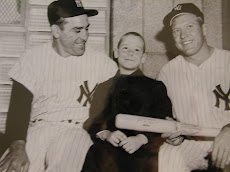
I had my picture taken sitting in between Mickey Mantle and Yogi Bara a photo that, if there were to be a “proud look on the face of a child” contest, would win without a close second.

Following that, we went up to the Yankees locker room, where I met many of the rest of the team, some of them naked, but none of them bothered by Pop and me. Except maybe Tommy Tresh, who just seemed to be not very nice.

Imagine being a seven-year-old boy at his first ballgame and experiencing that. Are you kidding me? It was beyond any dream my sleeping mind could have created.
It’s still a bit hard to grasp. That was my first ballgame.

Friday, April 10, 2009

The Abduction

During the months after we’d moved back into the house on 68th Street, I attended a semi-private school for professional children on Manhattan’s West Side called Lincoln Square Academy (LSA). It allowed young actors, dancers, musicians and other professional kids the flexibility to audition and take on a limited amount of paid work, while attending school. Although I wasn’t actively pursuing the biz, I think my father and step-mother hoped that the environment would inspire me to jump in.

Instead, the school introduced me to a new group of peers, many from a housing project in the Bronx, who inspired me to smoke pot, experiment for the first time with LSD, and pursue sex with a passion.

I rode the cross-town bus, to and from school, taking me through the Central Park cut- through known as “the transverse”, with only short walks to and from the bus stops on both ends of the daily journey.

On a near perfect Friday in the Spring of 1967 at about 3:30 PM, I walked alone from LSA to the 65th Street Lincoln Center bus stop with my hi-top gym sneakers, tied at the laces and slung over my shoulder and my new suede Beatle boots on my feet. The sun shown bright and warm on my face.

My mind wandered as I walked. I was in obsessive lust with a girl from the Bronx named Michelle, who I’d seen naked in a bathroom at a school dance the previous weekend. A group of us had gone to the dance and discovered, much to our distress, that the dance had reached it’s limit of boys and school officials were allowing only girls to enter.

My friend Phil and I exchanged clothes – dresses, stocking - with Michelle and another girl, who then applied makeup, gave us their earrings and did our hair with an adequate level of professionalism to get us past the ticket sentry at the door. While in the girl’s bathroom, changing clothes back in to our own, Michelle had let me briefly touch her naked crotch, a first for me, which naturally caused me to fall in love with her. I couldn’t get her out of my mind, as I made my way to the bus stop.

I stood a foot back from the curb under some construction scaffolding, waiting for the bus. I was a relatively street-wise 13-year-old, out of school for the weekend, concerned only with what parties my friends and I would have available to us over the coming weekend and proud to be seen in my new black suede Beatle boots.

The construction site on 66th Street and Broadway would eventually become Avery Fisher Hall, the large theatre and concert facility that would become part of the new Lincoln Center complex. I walked a few steps out into the street, looking to see if the bus was in sight.

As I returned to the sidewalk, no more than two steps under the scaffolding, a large Hispanic man, around 20 years old, stepped in front of me, blocking my path. As I attempted to move around him he countered each step I took with one of his own and put one hand on my chest, moving in almost close enough to touch his whole body to mine. I looked up at him with mild disbelief, and smiled.

I was about say something when I felt the point of a knife poke into my abdomen.

“You feel that? Give me your money,” he said. “and don’t scream or say nothin’ or I’ll fuckin’ cut chou.” I didn’t doubt that he meant what he said. I could see the truth of it in his angry, glassy brown eyes. He was big - huge compared to me - and I felt even smaller, perhaps because of the knife sticking in my belly. The fact that it was a small knife did nothing to assuage my fear.

“All I got is bus fare, man.” I said meekly. It was true. I had nothing more than the fifty cents that would get me home. “Swear to God!”

Having uncovered only the fifty cents, he grew frustrated. He ordered me to take off my boots and socks. I felt a sense of disbelief as he backed me up against graffiti-covered plywood construction barrier. This guy was robbing me at knifepoint in broad daylight at one of the busiest intersections in the largest city in the United States and it was literally as if we were invisible. No one even looked - let alone stopped to help!

Frustrated, he cursed in Spanish, as if having no more money to rob me of was shameful. He covered most of the handle and blade of the knife with his right hand, leaving only a half-inch or so sticking out between his thumb and forefinger. He put his right arm around my right shoulder, sticking the tip of the blade right onto my carotid artery. I felt my pulse throbbing out onto the knife with each heartbeat.

“Walk with me like you’re my boy, and I won’t hurt you.” he said.

I did. No resistance from me whatsoever, as we walked south on Broadway, out from under the construction scaffolding and into the bright sunshine. We passed a police officer, leaning against a support pillar off to our right and I weighed the possibility of trying to attract his attention, but his focus was away from us and I didn’t see a way to attract his attention without endangering myself. Or maybe I could just try to break away from his grip. As I inventoried all of the contact points where he held me, the tension I felt told me that he was alert to any moves I might make. No way to make a break for it.

“Just like we best amigos, little boy, you hear me?” The tip of the blade on by throat guaranteed my compliance; left me no alternative to doing as he wanted.
“Okay” was all I could muster.

Once past the cop, with no warning, he grabbed my left wrist with his left hand.

“I show you something nice, boy, you wanna feel something nice?” I said nothing, having no idea what he was talking about. I continued, desperately now, to look around for an escape route, feeling the tip of the blade poking into my neck. Suddenly he jerked my hand over to his body and pressed it onto the front of his pants. I felt the half hardened swell of his penis as he pushed my hand onto it. I jerked my arm away and winced in total disgust. Now I felt sick to my stomach. Ha laughed and said: “You like that, little boy, eh?”

I managed a faint, whiny “No!”, as I tensed, shrinking away from as much as he’d let me. I was now so frightened, I couldn’t even think.

Then, as we started moving southwest, across the large plaza area of Lincoln Center, my captor gave me what turned out to be an invaluable piece of information. He turned to me as he guided me along, and with an evil, leering smile, he shared with me his plans for what awaited me.

“Little boy, you and me’s gonna have us some fun. I gonna take you home wit’ me, back to my project. I’m gonna tie ya ass down on my bed and I’m gonna beat cha ass with a chain.” His smile widened. “And then I gonna fuck you in da ass, little boy.” His smile remained, stretched even wider as he licked his lips and winked, as if to seduce me. My heart jumped into my throat. My fear was now so great, my body ached with it. My head tightened as I tried to think of what to do. I imagined him and I in a smelly, filthy, roach-infested room, him standing over me with that horrifying half smile……

We had changed direction as we crossed through the large open plaza area, past where one day a fountain would cascade water, and offer a rest area for tourists and locals. We were almost out of the relative safety of Lincoln Center, and heading for a cut-through to the housing projects he had spoken of. We headed towards the far building of the complex, beyond which the dazzling theatrical pomp and glitter of Broadway gave way to the dark side of this neighborhood. It was this area of gangs and projects on which the tale of West Side Story had been based.

I struggled to think clearly. What can I do? I asked myself. What can I possibly do?

The first option that came to me was: Stay calm and go with him. He said he wouldn’t hurt me if I didn’t cause trouble.

No way. I’ll die. After he rapes me, he’ll kill me, for sure.

Run back to the cop was my next thought. But how could I do it with the knife at my throat? I questioned my ability to pull it off without be slashed, perhaps fatally.

There was an incredibly strong pull just to keep walking and hope for the best, to believe that he wouldn’t hurt me if I didn’t resist. He hadn’t yet.

As we neared the far corner of the plaza, the point beyond which all my options would dwindle to none, a kind of mental lucidity kicked in and I began to think and plan in a linear and analytical way that seemed to appear from nowhere.

I began a sequence of extraordinarily logical, rational and quite astute thoughts that presented to me a plan that might allow me, if executed with precision and perfect timing, to escape.

First, it occurred to me that my sneakers, laces tied together and slung over my right shoulder, were within reach of my right hand. I noted peripherally that, with our bodies aligned side-by-side as they were, he was unlikely to see any small movements that I made with my right hand. I tested this by moving my hand slowly up and down my right side until, feeling certain that he didn’t notice, I hooked my thumb through the laces. I gradually tightened my grip until it was secure enough to control and maintain my grip on the laces. I glanced down toward the spot that he’d placed my hand on. I could judge fairly well the position of the sneaker and length of the laces as it banged on the right side of my back as we walked.

I realized I’d have to move towards him, ducking down and to the left, while I swung the sneakers, before I could break away. I’d have to move explosively fast as well as precisely.

I realized fully and with a degree of calm now, that whatever I chose, it wasn’t going to be easy and that, either way, I was taking a huge risk. But my plan seemed good and it was all I had.

He hadn’t let up the pressure of the knife on my neck at any time throughout our entire walk. He seemed ever cognizant that this was his means to keep his catch from escaping and, seemingly without thought, he kept it pressed firmly on my carotid artery, perfectly poised to stop any attempt I might make to escape.

Just as we arrived at the southwest corner of the Lincoln Center Plaza, almost out of view of anyone who might help, I swung the sneaker attached to the laces in my right hand and simultaneously ducked down and away from the blade. I drove the sneaker between his legs as hard and as fast as I could. The sneaker landed almost perfectly– well enough to double him over and cause him to yell out in pain. I straightened up and ran for my life.

I ran straight back across the large plaza to the policeman, who was where we had passed him. Out of breath, shaking and frightened, I ranted: “Sir that man over there, he robbed me, he has a knife! He told me he was gonna take me to his house and beat me and rape me and do a lot of things to me. Please!! Get him!!”

The officer looked at me, a smile calmly breaking across his face.
“Now son, what did you do to get yourself involved a him to begin with?”

“No, sir, he robbed me. He has a knife. He took my bus fare and then he put the knife on me and started taking me home with him. Look – he’s right there. You can get him!”

Nothing.

“Son, tell you what. Here’s fifty cents.” He reached into his pants pocket, fishing for change. Came out with some. Pulled out a quarter, two dimes and a nickel. “You go on home now and stay out of trouble, you hear?”

I was stunned. I looked at the change in my hand. I started to back away from the cop, unable to believe what he’d just said to me. I turned and walked away, looking across the plaza and watched as the guy who wanted to rape and beat and probably kill me, a grin on his ugly face, turned the corner at the far end of the Opera House, and disappeared.

I took the bus home and sat in my room, shaking for the better part of the afternoon.

I never told anyone what happened that day until nearly thirty years later, when I began teaching women’s self-defense classes. Turns out my story had a lot in common with those of many women who go through the horror of being raped and other trauma.

It wasn’t until I’d told this story in workshops many, many times, that I finally remembered that my abductor had forced me to touch his crotch. I’d simply buried that, way down in the recesses of my memories, as if I refused to know it anymore. The trauma of abuse is huge, a monster that terrifies and injures way more deeply than just the physical scars show. Just when we think we’ve cut the monsters head off, it jumps out laughing from behind a door that we thought we had closed long ago.